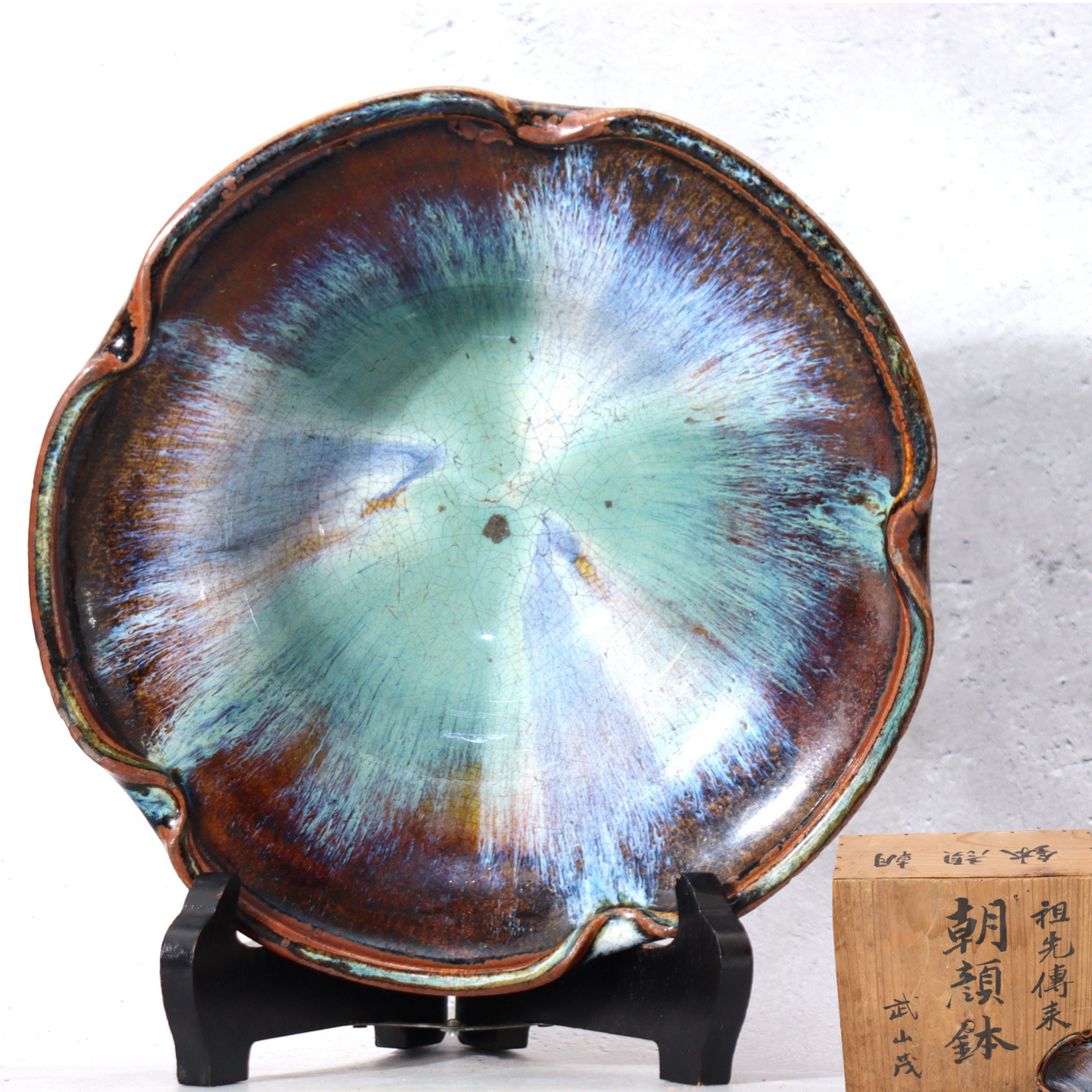
In Japan, there is a long-running television show called Kaiun! Nandemo Kanteidan — roughly, “Good Fortune! What’s It Worth?” For over thirty years, ordinary people have brought antiques and art to a panel of expert appraisers to learn what they actually own. Over the last decade, a particular kind of guest has appeared on the show with increasing frequency: people who bought pieces on Yahoo Auctions Japan and want a real expert to tell them what they have.
The results are instructive.
One of the most discussed episodes involved a tenmoku tea bowl presented as a possible yōhen tenmoku — the rarest category of Chinese Song-dynasty tea bowl, of which only a handful of examples exist in the world, several designated National Treasures in Japan. The appraisers valued the piece at 25 million yen (roughly $165,000 USD) and called it the most significant discovery in the program’s history. In the months and years that followed, other specialists publicly disputed the attribution, and online discussion raised the possibility that very similar pieces had circulated on Yahoo Auctions for a tiny fraction of that figure. The debate has never been fully resolved.
This is the world Western collectors enter when they open Yahoo Auctions Japan. The inventory is real. The bargains are real. The forgeries and misattributions are also real, and they are sometimes sold by sellers who genuinely believe their own descriptions.
I run Koedo Sun Art, a specialist antique shop in Kawagoe, outside Tokyo. I occasionally buy on Yahoo Auctions myself — it is not my main sourcing channel, but for certain pieces it is useful. What I want to share in this article is honest guidance about when Yahoo Auctions makes sense, how to identify the sellers worth buying from, and when a specialist shop is the more sensible path. I am writing this as a dealer, but the advice applies whether you buy from us or from anyone else.
The Five Ways to Buy Japanese Antiques Online
There are realistically five paths a Western collector can take, each fitting a different kind of buyer.
Yahoo Auctions Japan, accessed through a proxy service like Buyee, FromJapan, or Jauce, is by far the largest marketplace — tens of millions of listings at any given moment. Rewards patience, specialized knowledge, and risk tolerance.
eBay and Etsy offer the most familiar experience for Western buyers, but the antique-Japanese-ceramics category contains a high proportion of reproductions and Showa-era pieces listed as “antique.”
Western auction houses (Bonhams, Christie’s, Sotheby’s, regional houses) handle the highest tier. Authentication is rigorous, but a 25 to 28 percent buyer’s premium applies.
Japanese specialist shops with online stores are smaller in inventory, but curated and authenticated, with English support for international buyers.
Antique fairs in Japan — Heiwajima, Kyoto, the monthly temple markets — remain the best experience if you can travel.
The real question is not “which is best.” It is “which fits what I am trying to do right now, with what I currently know?”
The Honest Case for Yahoo Auctions Japan
If you have the time, the Japanese-reading ability, and the risk tolerance, Yahoo Auctions can genuinely be rewarding.
The inventory is unmatched. Roughly 30 million listings move through the site at any given moment. No specialist dealer, no Western auction house, no online marketplace can match that scale.
Long-established Japanese antique dealers list on Yahoo Auctions too. Respected specialist shops and veteran dealers use the platform as a secondary channel — to clear inventory, move regional pieces, or reach collectors outside their local customer base. When you buy from one of these dealer-sellers, you are buying essentially the same expertise a traditional shop offers, through a different interface. The next section is about how to identify them.
Bargains do exist, especially on pieces that don’t translate well in photographs. Bizen ware looks dull under flash. Subtle iron-glaze celadon photographs as muddy gray. Pieces with quiet beauty sometimes close at far less than they would in a shop where you could see them properly.
The proxy ecosystem has matured. Buyee, FromJapan, Jauce, Japan Rabbit, Neokyo, and others have processed millions of transactions over more than a decade. Most of the time, they work as advertised.
So if Yahoo Auctions is a legitimate option for many buyers, what actually separates the sellers you can trust from the ones you cannot?
How to Identify a Trustworthy Seller on Yahoo Auctions
This section is the practical core. Among the thousands of sellers listing Japanese antiques on Yahoo Auctions, a very small number are genuine specialists whose work rises above the rest. I personally watch a handful of such sellers closely — including two or three whose sourcing operations are deeply impressive. They work in different styles, but good pieces consistently end up in their hands. It does not happen by accident. One of them I occasionally see at the same regional markets I attend; he travels extensively on foot, visiting old households and regional dealers across the country, and the quality of his inventory reflects that effort. Finding sellers of this caliber is possible, but it requires knowing what to look for. Here are the checks I apply.
Check the seller’s self-introduction page (jikoshōkai). Serious dealers list their shop name, physical address, and contact information clearly. Many display their kobutsushō kyoka number — the antique dealer license required by Japanese law for anyone trading in secondhand goods professionally. A seller listing thousands of antique items with no shop name, no address, and no license number is a reason to move on, regardless of how attractive a specific piece looks.
Search the shop name separately. A real antique dealer usually has a physical shop, a website, and years of online presence outside Yahoo Auctions. Google the shop name. If the dealer has been operating for decades, with a street address you can find on a map, that tells you something a feedback score alone cannot.
Read how the seller describes their pieces. A serious dealer writes like a dealer — describing period honestly, noting chips, hairlines, and restorations, using correct ceramic terminology. Vague descriptions like “old piece, unknown age” on expensive items are cautionary. So is the opposite: descriptions that sound like marketing copy, with superlatives but no specifics.
Look at the photography. Experienced dealers photograph under natural or neutral light, from multiple angles, with close-ups of the foot, signature, and any flaws. Overly bright flash that flattens the surface, or a single hero shot with no detail images, suggests either an inexperienced seller or one who prefers you not look too closely.
Review the seller’s other current listings. If the dealer specializes in tea ceramics, their other listings should form a coherent body of work. A seller whose inventory jumps from authentic-looking tea bowls to obvious reproductions to unrelated categories is not a specialist.
Check feedback carefully, but not naively. Read the comments, not just the score. A long-established shop will have hundreds of detailed positive comments from repeat buyers over years. A high score built on hundreds of low-value transactions in three months is not the same thing.
My Own Pre-Bidding Routine
Before I place any bid on Yahoo Auctions, I do three things without exception.
I review every other item the seller currently has listed. Ten or twenty other pieces tell me far more about a seller’s expertise and honesty than a single item does. If the surrounding inventory does not match the claimed specialization, I do not bid.
I read their feedback in detail, especially recent negative or neutral comments. One disputed transaction can be a misunderstanding. A pattern of condition complaints or slow responses is not.
I do not chase bargains. This is the hardest rule and the most important one. If a piece looks dramatically underpriced for what it appears to be, there is almost always a reason — usually one I cannot see from the photographs alone. The rare exceptions exist, but pursuing them responsibly requires time I am not willing to spend on most purchases. The hours needed to properly evaluate a genuinely tempting “find” — examining similar sold examples, researching the seller’s history, cross-checking against auction records — often exceed the potential savings. For a collector building a collection rather than trading for profit, the math rarely favors the chase.
What Yahoo Auctions Still Cannot Do
Even with the best seller, working through Yahoo Auctions has structural limits no proxy service can fill.
Authentication is on you. The proxy ships what wins. They handle bidding, payment, customs, and shipping — not evaluation.
Returns are effectively impossible. Once a piece has crossed customs into your country, returning it is logistically and financially prohibitive in most cases.
Total cost is rarely what you bid. Item price plus auction fees plus proxy service fees (typically 5 to 15 percent) plus Japanese domestic shipping plus international shipping plus customs duties plus currency conversion can land 40 to 70 percent above the winning bid. A winning bid of ¥30,000 (about $200 USD) for a small ceramic piece typically resolves to roughly $310 to $340 by the time it reaches a US or EU address.
The picture-and-description gap is real. Even senior appraisers on Nandemo Kanteidan, examining pieces in hand under studio lighting, regularly disagree. Images on a screen cannot substitute for physical examination — the weight, the ring of the glaze when tapped, subtle wear patterns.
There is no relationship. If you collect seriously over years, having someone who knows what you are looking for is more valuable than any single transaction.
When a Specialist Shop Is the Better Choice
A specialist shop is the better fit when you are still developing your eye, when you want something specific on a known timeframe, when documented provenance matters, or when you want to ask questions about a piece in your own language.
A good specialist shop — ours or someone else’s — should offer the following: clear photography from multiple angles including the foot and any flaws, honest dating with reasoning rather than vague “antique” labels, condition notes mentioning chips and restoration where present, transparent shipping costs quoted before purchase, and someone you can email with questions. If a shop does not meet these basics, look elsewhere.
For context: our shop, Koedo Sun Art, operates from Kawagoe — a former castle town outside Tokyo also known as “Little Edo” for its preserved historical streets. We source pieces at Japanese markets, dealer auctions, and through relationships with collectors and estate sales, then ship worldwide. We are one option among several, and the rest of this article applies whether you buy from us or not.
The Hybrid Approach
Most serious collectors I know eventually use both paths.
In the first one to three years, they buy almost entirely from specialist shops. Each purchase comes with explanation, context, and the confidence of authentication, building a reference collection — known-good pieces against which everything encountered later is mentally compared.
In years three to five, a mix emerges. Higher-value or unfamiliar pieces still go through specialist channels. Lower-value pieces in styles the collector now knows well start moving through Yahoo Auctions, always from verified long-established dealer-sellers.
After year five, many collectors handle Yahoo Auctions comfortably for familiar styles, while still calling on specialists for rare or technically complex pieces.
The question is not “Yahoo Auctions or specialist shop forever?” It is “where am I right now?” Even Nandemo Kanteidan’s professional appraisers, examining pieces in hand, disagree and occasionally err. For most people newer to Japanese antiques, the cost of a specialist shop tends to pay for itself in mistakes avoided during the first few years. After that, the math changes.
Where to Go From Here
If you are early in your collecting and want to spend with confidence, a specialist shop is usually the right answer — ours or someone else’s. If you have the time, the Japanese-reading ability, and the discipline to apply the seller-verification checks above, Yahoo Auctions can be genuinely rewarding once you know what you are looking at. For pieces above a few thousand dollars, a Western auction house with rigorous authentication remains the safest path.
The Nandemo Kanteidan episodes are worth remembering in both directions. Real discoveries are made through Yahoo Auctions — pieces ordinary people pick up cheaply sometimes turn out to be genuine and valuable. Confident attributions by experienced eyes can also be wrong. The market is real, the opportunities are real, and so is the need for caution and expertise.
Whichever path you choose, we hope this helps you collect with more confidence. If you would like to see what we currently have available, you are welcome to browse our shop. If you would like to be notified when new pieces arrive, our newsletter goes out once or twice a month — no more than that.